


Unfortunately — or fortunately — my writing day begins at night. I don’t plan it. I don’t sit down and say, “Now I will write.” It happens. It’s as if someone quietly knocks. And if I open that door — it’s over.
When I am in that state, I write day and night. I forget about time. About food. About messages. About everything.
That’s why I’m often amused — and sometimes slightly irritated — when someone calls me at 8 a.m. Or even better, when someone rings my doorbell without warning. It’s usually the postman. Or a random passerby selling something or asking for something.
And there I am, standing at the door, hair messy, still in my pajamas, trying to explain that my working hours are at night. I find myself justifying it and feeling slightly uncomfortable.
How do you explain to someone that you sleep only four or five hours, but your entire schedule is simply shifted? That your rhythm is different from most people’s?
It’s difficult. People don’t really understand.
Night is also my time for editing — for anything that requires silence and focus.
During the day, I have phone calls, obligations, meetings, arrangements. The day belongs to the world. The night belongs to me.
I usually start working around ten or eleven in the evening. I write until six, sometimes seven in the morning. Then I sleep for four, maybe five hours.
And somehow, I always feel like I owe someone an explanation for that. As if working at night were an odd habit rather than my natural rhythm. So I often say with a smile: I work the night shift — it makes it easier for people to accept. But I don’t know how to work any other way.
My favorite moment is when I open my laptop. That emptiness that doesn’t threaten — it invites. The words find me. I don’t go back to what I’ve written. I don’t analyze. I just move forward. I write and write and write. As if I’m catching something that might disappear if I pause. Later, I edit. I connect. I cut. I add.
It’s the same when I edit films.
I have my own studio at home, where I edit all my music videos and documentaries. Because editing, for me, is not technical work. It’s directing. It is the most important part of creation.
I direct while I edit. I direct while I write. Even on set, while looking at the monitor — that’s my role in the field — I am already editing in my head, even as I announce the next scenes we need to shoot.
And when I hit a block — and of course I do — I get into the car and drive. Then I turn the entire scene over from five or six different perspectives.
What if he says this?
What if she stays silent?
What does that mean for the next chapter?
For the next novel?
For the third?
If she leaves now — how will she return? What will she say?

When I was writing the trilogy, I knew that if I placed something in the first part, I had to know exactly how it would unfold in the second and how it would end in the third.
It is, in fact, a very obsessive job. And a beautiful one. Because writing is atmosphere.
While I was writing The Black Oath, the story took place in a deep autumn in Tara. Fog. Dampness. Weight in the air. And I felt it physically. Summer arrived — and I still felt moisture in my bones. As if I were living inside that fog. As if my body had absorbed the climate of the novel.
Until I released it.
It took time to return to reality. I wrote seven short stories in a row, slowly detaching myself from that world. It felt like coming off an addiction. Like carefully stepping out of a reality you created yourself.
When I write, nothing exists except coffee and silence. The phone is off. The door is closed. The world is muted. Writing is not a job for me. It is rhythm. Passion. Breathing. I don’t force myself to write — writing, perhaps, forces me. When I finish, I simply collapse into bed. I sleep little, and restlessly. Because I can’t wait to continue.
During breaks, I get into the car, grab my coffee to go, open the window and let oxygen and nature in. And the same feeling always comes over me: complete release. It is incredible how every written sentence feels like a fragment of freedom. That’s why I return. Again and again.
That’s more or less what my day looks like. Or night.
When I write, I don’t snack. I don’t eat. I simply breathe and write. It’s hard to socialize in those moments because, naturally, my friends don’t fully understand the state I’m in. So I isolate myself.
Yes, I am obsessive. Intense. Passionate. And completely my own.
I always write in the same place — in my comfortable armchair, with the laptop on my knees. Next to me there is always a glass of water or lemonade, hand cream, and the perfume I love — Davidoff Cool Water.
It is always interesting when someone tries to pull me back into reality while I’m writing. It’s hard for me to start an ordinary conversation because I’m not really “there.” I’m fully inside. I remember once sitting with a friend. She was talking, asking me questions, and I felt as if I were living a parallel life.
At one point she looked at me and said, “What are you thinking about right now? Where are you?”
I replied, “Sorry. I’m in a scene.”
She was fascinated. “What kind of scene?”
And how do you explain to someone everything you’re feeling in that moment? It’s difficult. And besides, writing changes. The very next night that scene may be gone, replaced by something entirely new.
My scenes always have a scent. They have food. Glasses on a table. Moisture in the air. The sound of cutlery. Atmosphere you can touch. Food has always been important to me. In life and in writing. I was never drawn to crowds, bars, or nightclubs. I wanted to hear who was speaking and what they were saying. My worlds were built at home. Board games. Gatherings. Tuna pâté. Pancakes with Nutella. People came to my place because they knew things would be simple, clear, concrete — and there would be food. Who doesn’t love tuna pâté and pancakes with Nutella?
I remember one of my gatherings at the top of a high-rise building in Rijeka, in my apartment. I affectionately call it “The Loft,” because it’s neither in the sky nor on the ground.
There were many unfamiliar people. Voices. Laughter. Strange combinations of personalities. And I stood there, serving, observing — yet at the same time entirely inside my own internal film. I am always both hostess and observer. Participant and author. I enjoy those social encounters. I love meeting new people — not all of them — but those who are different or creative immediately intrigue me. I want to explore them. Their lives. Their perspectives.
Something similar happened recently. I was writing all weekend when a friend came from Belgrade to stay with me. I told him, “Please don’t. I’m working. I won’t be able to give you attention.”
He replied, “You just work. I’ll read. It’s enough that we’re together.”
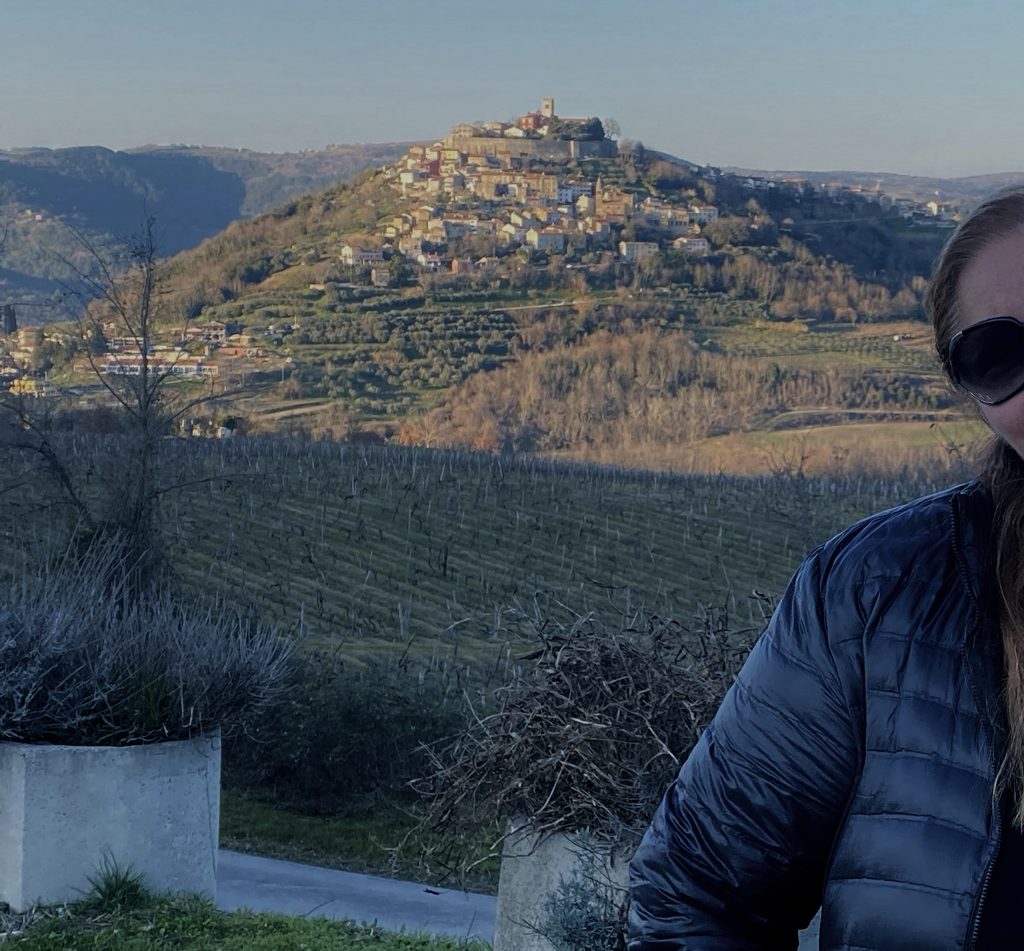
He didn’t disturb me. But I couldn’t relax. I felt the need to organize an outing, to go to Motovun, to walk, to be a good host.
We went. We talked. We analyzed my older novels. He said they were perfect airplane books — the kind you read in one breath. He writes too. He’s an excellent journalist. He understood the process.
But I was simply waiting to return home. To sit down. To continue. Everything else felt temporary.
My sister is one of the rare people who truly understands this state. During those intense creative periods, we speak every day. As if we’re having coffee together. As if she grounds me. She once even came earlier than planned, just to be beside me — to feed me with real food and with reality. She worries about me in those moments. But she understands. She supports me.
It’s hard to explain this process. When I write, I don’t imagine atmosphere — I feel it. If it’s foggy, I feel moisture in my bones. If it’s sunny, my skin warms. If it’s raining, I hear it in the windows.
Maybe these anecdotes aren’t important. Maybe what matters is that writing has never been a job for me.
It is simply a state. A kind of parallel life.
Maybe it’s not a conventional life. But it’s mine.
See you over coffee!